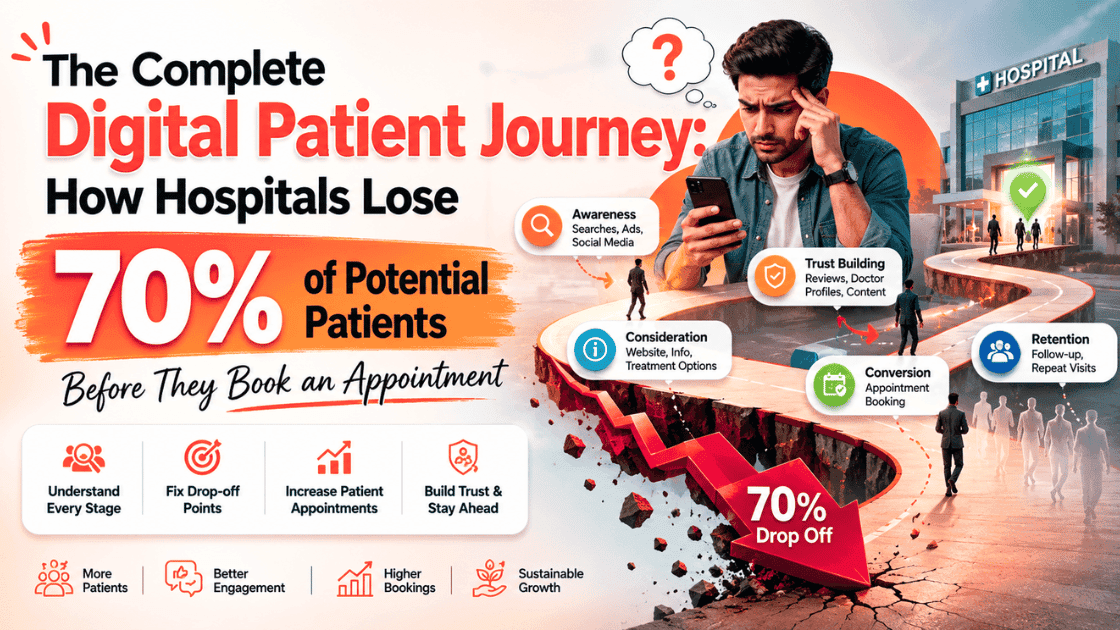
Opening Story
How hospitals lose potential patients across awareness, trust, consideration, conversion, and retention before an appointment is ever booked.
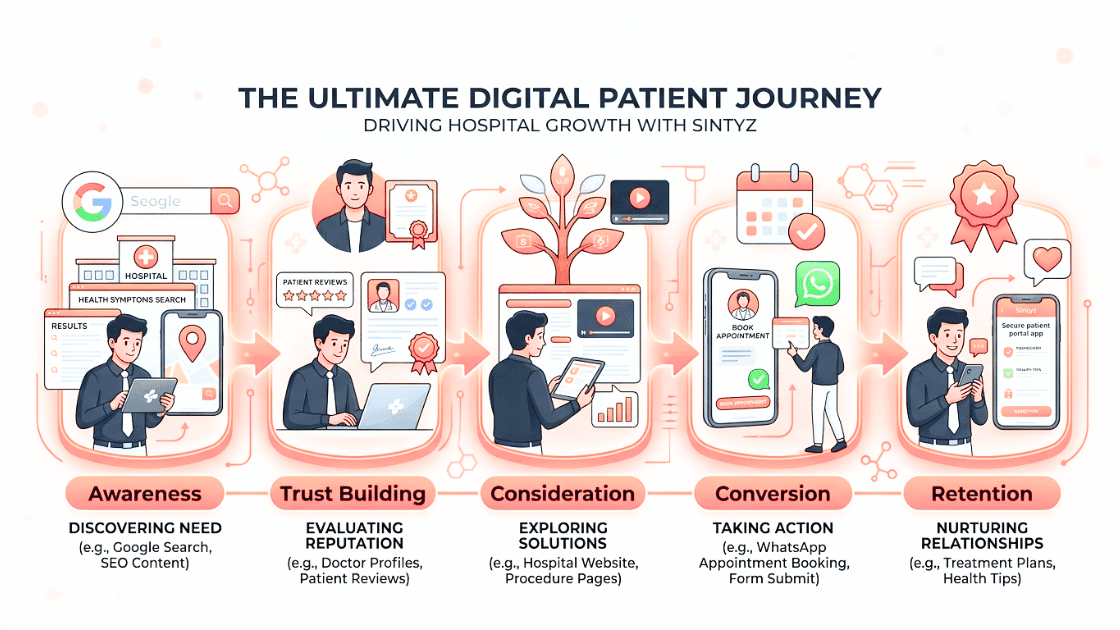
Digital Patient Journey
Every appointment begins long before the booking form.
Awareness
Next stage ↓
Trust Building
Next stage ↓
Consideration
Next stage ↓
Conversion
Next stage ↓
Retention
Common Mistake
Hospitals treat digital journeys as separate assets: website, ads, reviews, SEO, and follow-up all handled in isolation.
Key Takeaway
Patient acquisition improves when each digital touchpoint reduces confusion and moves the patient toward trust.
Best Practice
Map the journey from search to follow-up before spending more on traffic, redesign, or campaigns.
Meet Rahul: Your Next Patient Who Never Booked
Imagine this.
Rahul is 38 years old. He works in a corporate job, spends long hours sitting at a desk, and rarely gets time to focus on his health.
For the past few weeks, he has been experiencing occasional chest discomfort. At first, he ignores it. Like many people, he assumes it is stress, lack of sleep, or acidity.
One evening, the discomfort returns while he is driving home. This time it feels different. He becomes concerned. He takes out his phone and searches: "Chest pain specialist near me."
At that moment, Rahul becomes a potential patient. The question is:
Will he become your patient or your competitor's patient?
Most hospital owners assume that if they are running advertisements, posting on social media, or have a website, they are capturing patients like Rahul. The reality is very different.
Research across industries consistently shows that customers rarely make decisions during their first interaction with a business. Healthcare is no exception. Patients move through a journey. They search. They compare. They verify. They evaluate. They hesitate. They trust. Then they book.
Unfortunately, many hospitals unknowingly lose patients at every step of this journey.
By the time Rahul books an appointment, he may have visited five websites, checked multiple doctor profiles, read dozens of reviews, watched videos, and interacted with several digital touchpoints.
If any one of those touchpoints creates friction, he leaves. Not next week. Not tomorrow. Immediately.
This is why many hospitals lose up to 70% of potential patients before an appointment is ever scheduled.
Let's walk through Rahul's journey and discover where hospitals lose patients—and how to prevent it.
The Healthcare Consumer Has Changed Forever
Ten years ago, patients behaved differently. A family member recommended a doctor. A neighborhood physician referred a specialist. People visited the nearest hospital. Trust was built offline. Today, trust begins online.
Before visiting a hospital, patients now perform extensive research. Think about your own behavior.
When you purchase a mobile phone, book a hotel, choose a restaurant, or hire a service provider, what do you do first? You search online. Patients do exactly the same thing.
The difference is that healthcare decisions are often more emotional and more important. Patients are not simply purchasing a service.
They are making decisions about their health, their family, and sometimes their survival. This makes trust even more important.
The hospitals that understand this shift are growing rapidly.
The hospitals that ignore it are becoming increasingly invisible.
Stage 1: Awareness — The Moment a Healthcare Need Appears
Let's return to Rahul. He searches: "Best cardiologist near me." Immediately Google displays multiple options. Some hospitals appear in search results. Some appear in Google Maps. Others appear through advertisements. Several hospitals don't appear at all. Now ask yourself an important question:
If your hospital is invisible at this stage, does anything else matter? The answer is no. Patients cannot choose what they cannot see. Visibility is the foundation of patient acquisition.
Google Search Is the New Hospital Reception Desk
Many hospitals still think of their building as the first interaction.
In reality, Google has become the new reception desk.
Before patients see your hospital, they see your search results.
Before they speak to your staff, they read your website.
Before they trust your doctors, they evaluate your online presence. Every day, patients search for:
- Cardiologist near me
- Orthopedic hospital in Gurgaon
- Best IVF center
- Knee replacement specialist
- Child vaccination clinic
- Diabetes treatment center
Each search represents intent. Each search represents opportunity. Each search represents a potential patient.
Yet many hospitals fail to optimize their websites for these searches.
As a result, competitors capture patients before the race even begins.
The Power of Local Search
Let's imagine Rahul continues searching. Now he opens Google Maps. He sees three hospitals. One has 1,800 reviews. One has 450 reviews. One has 32 reviews.
Without realizing it, Rahul has already formed an opinion.
Patients naturally associate higher review volume with trust.
This is why local SEO has become one of the most important patient acquisition strategies available today. When patients search:
- Hospital near me
- Emergency care nearby
- ENT specialist near me
Google prioritizes local relevance.
Hospitals with optimized Google Business Profiles, strong reviews, updated information, and active engagement gain a significant advantage.
Hospitals without these elements lose visibility before the conversation even starts.
Social Media: The Modern Discovery Engine
Not every patient starts with Google. Some discover healthcare providers through social media. Imagine Rahul scrolling Instagram.
He sees a short educational video from a cardiologist discussing early warning signs of heart disease. He watches. He relates. He follows the page.
A few weeks later, when symptoms appear, he remembers that doctor. Awareness has already been created.
This is the hidden power of healthcare content.
Patients often connect with expertise long before they become patients.
Stage 2: Trust Building — Where Most Hospitals Lose Patients
Visibility gets attention. Trust gets appointments. Let's continue Rahul's journey. He clicks on three hospital websites. Within minutes, he begins comparing them. Not consciously. Automatically. Every visitor does this.
Doctor Profiles Matter More Than Most Hospitals Realize
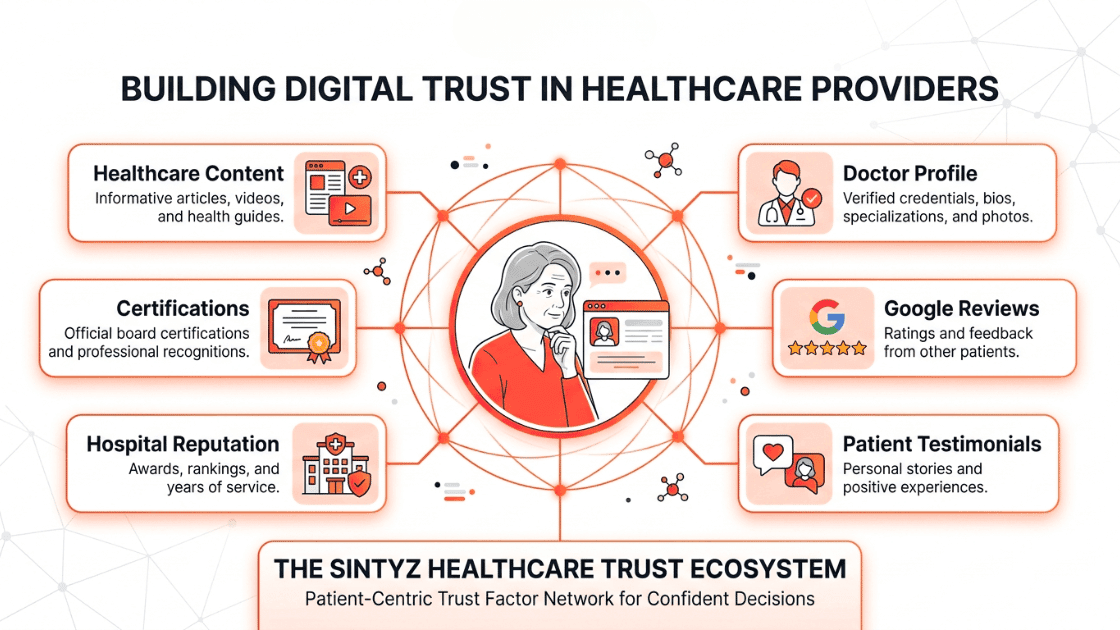
Rahul wants to know one thing: "Who will treat me?" Many hospitals make a critical mistake. Their doctor profiles contain little more than:
- Name
- Qualification
- Department
That's not enough. Patients want confidence. They want expertise. They want reassurance. A strong doctor profile tells a story. It highlights experience. It explains specialization. It demonstrates credibility.
It helps patients imagine themselves in safe hands.
The hospitals that invest in doctor branding consistently build stronger patient trust.
Reviews Are the New Word of Mouth
Rahul now checks reviews. You would do the same. Every patient does. He reads: "Doctor explained everything clearly." "Excellent staff." "Appointment was delayed for two hours." "Great experience." "Very professional." Within seconds, trust begins forming. Or breaking.
Many hospitals underestimate the impact of online reviews. Patients don't.
For many people, reviews are the deciding factor between booking and leaving.
The Hidden Power of Patient Stories
Facts convince. Stories connect.
Imagine Rahul reads about a patient who experienced symptoms similar to his own. He learns how the condition was diagnosed.
He sees how treatment improved quality of life. Suddenly the hospital feels more relatable. More human. More trustworthy.
Patient testimonials bridge the gap between medical expertise and emotional reassurance. That connection is incredibly powerful.
Educational Content Creates Confidence
One hospital website contains: "Book Appointment." Another contains:
- Articles
- Videos
- Treatment guides
- Frequently asked questions
Which one feels more trustworthy? The answer is obvious. Patients trust organizations that educate them. Educational content reduces uncertainty.
And uncertainty is one of the biggest barriers to healthcare conversion.
Stage 3: Consideration — The Silent Comparison Phase
At this point Rahul has narrowed his options. Now he begins evaluating.
This is where hospitals frequently lose patients without realizing it. No complaint. No feedback. No warning. The patient simply disappears.
Your Website Is Either Building Trust or Destroying It
Imagine Rahul clicks your website. The page takes eight seconds to load. Images are broken. The layout looks outdated. The mobile experience feels frustrating. What happens next? He leaves. Not because your doctors are unqualified. Not because your treatments are ineffective. Not because your hospital lacks expertise.
He leaves because the digital experience created doubt.
Patients often judge healthcare quality through digital quality. Fair or unfair, that is reality.
Patients Want Information, Not Marketing
Many healthcare websites focus heavily on promotion. Patients want clarity. They want answers. They want guidance. Questions patients ask include:
- What treatment options are available?
- How long is recovery?
- What are the risks?
- How experienced is the doctor?
- What should I expect?
Hospitals that answer these questions reduce friction. Hospitals that hide information increase hesitation.
Pricing Transparency Is Becoming More Important
Healthcare decisions involve financial considerations. Patients appreciate transparency. They understand that exact costs may vary. However, providing guidance builds trust.
When patients cannot find basic information, uncertainty increases. And uncertainty delays decisions.
Stage 4: Conversion — Turning Interest into Appointments
Now Rahul is ready. He has decided. He wants to book. This should be the easiest part. Yet many hospitals make it surprisingly difficult.
Complicated Booking Systems Kill Conversions
Patients expect convenience. They can order food in minutes. Book flights instantly. Schedule meetings automatically. Why should healthcare be harder? Every additional step creates friction. Every unnecessary field reduces conversions. Every technical issue costs appointments.
The best booking systems are simple, fast, and mobile-friendly.
Why WhatsApp Has Become a Healthcare Essential
Imagine Rahul has one question before booking. He doesn't want to call. He doesn't want to fill a form. He wants a quick answer.
If a WhatsApp button is available, he messages instantly. If not, he may leave. Healthcare communication has changed dramatically. Patients increasingly expect immediate and convenient interaction.
Hospitals that ignore this trend often lose patients to organizations that embrace it.
The Importance of Call Tracking
Many hospital inquiries still happen over the phone. Unfortunately, numerous hospitals have no idea:
- Which marketing channels generated calls
- How many calls were missed
- Which campaigns converted into appointments
Without tracking, improvement becomes difficult. What cannot be measured cannot be optimized.
Stage 5: Retention — The Opportunity Most Hospitals Ignore
Here's a surprising truth.
Acquiring a new patient is usually more expensive than retaining an existing one.
Yet many hospitals focus almost entirely on acquisition. This is a costly mistake.
Healthcare Is Built on Relationships
Imagine Rahul receives exceptional care. His treatment is successful. His experience is positive. The journey should not end there. Hospitals should maintain communication through:
- Follow-up reminders
- Preventive care recommendations
- Annual health checkup notifications
- Wellness programs
These touchpoints strengthen relationships.
Review Collection Should Be Automated
Most happy patients never leave reviews. Not because they are unwilling. Because they were never asked.
Simple automated review systems can dramatically improve reputation management. More reviews create more trust. More trust creates more appointments. The cycle reinforces itself.
Loyal Patients Become Brand Ambassadors
Satisfied patients don't simply return. They recommend. They share experiences. They influence friends and family.
Over time, patient retention becomes one of the strongest growth engines available to healthcare organizations.
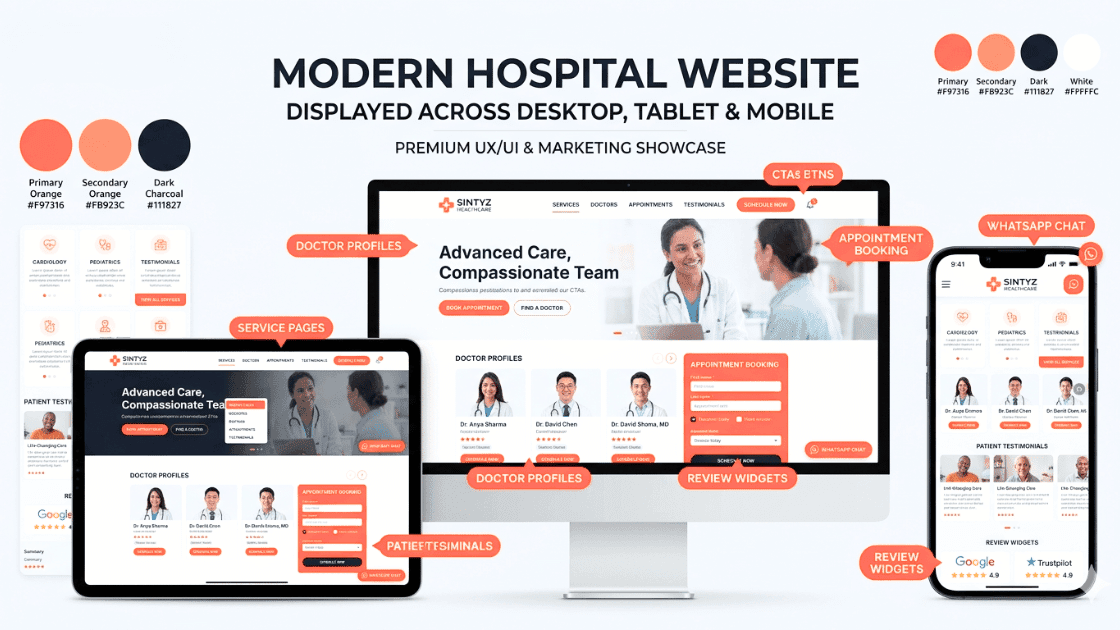
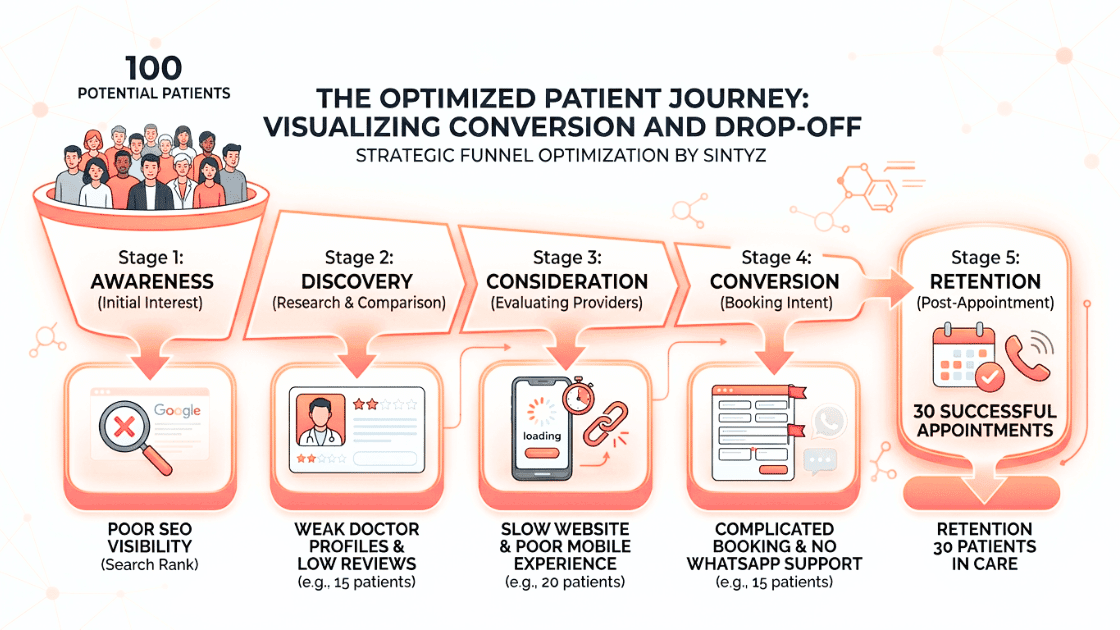
Why Hospitals Lose 70% of Potential Patients
After analyzing hundreds of healthcare websites and patient journeys, the same issues appear repeatedly.
Slow Websites
Patients leave before pages load.
Poor Mobile Experience
Most searches happen on mobile devices.
Weak Doctor Branding
Patients struggle to evaluate expertise.
Missing Reviews
Trust signals are insufficient.
No WhatsApp Communication
Patients cannot engage instantly.
Lack of Educational Content
Questions remain unanswered.
Poor Booking Experience
Patients abandon forms.
No Follow-Up System
Relationships end too early. Each issue seems small individually. Together, they create massive patient leakage.
The Difference Between Marketing Activities and a Patient Acquisition System
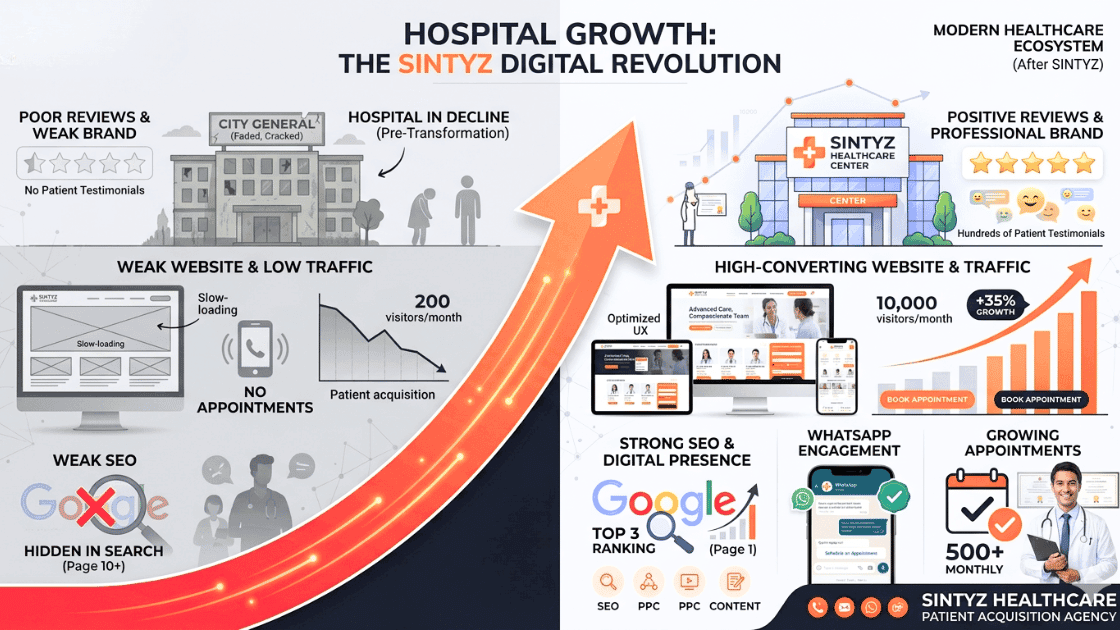
This is where many hospitals make a strategic mistake. They run campaigns. They post on social media. They buy advertisements. They redesign websites. But these activities often operate independently. Patients don't experience healthcare that way. Patients experience a journey. A connected journey.
A journey where every touchpoint influences the next.
The hospitals growing fastest today are not necessarily spending the most money. They are creating the smoothest patient experience. From Google search to appointment booking. From consultation to follow-up care. From first interaction to lifelong loyalty.
Final Thoughts
Every day, patients like Rahul search for healthcare providers. Some become patients. Many disappear. Not because they didn't need treatment. Not because they chose not to act.
But because somewhere along the digital journey, friction replaced trust.
The future of healthcare marketing is not about generating more clicks, impressions, or website visits.
It is about understanding the complete patient journey.
Hospitals that optimize awareness, trust, consideration, conversion, and retention create a predictable system for growth.
The question is no longer whether patients are researching healthcare providers online. They already are. The real question is:
When your next potential patient begins that journey today, will they find confidence in your digital presence—or will they choose someone else?
Expert Contributor
Expert ContributorSintyz Team
Healthcare Growth Strategists
Healthcare growth specialists focused on patient acquisition, medical website strategy, search visibility, and conversion systems.
Experience
5+ years
Specialization
Healthcare SEO, patient acquisition, and medical website strategy
FAQ
Frequently Asked Questions
The digital patient journey refers to every online interaction a patient has with a healthcare provider before, during, and after booking an appointment. It includes search engines, hospital websites, doctor profiles, reviews, social media, appointment booking systems, and follow-up communications.
How Sintyz Helps Healthcare Organizations
Turn patient journey gaps into a growth system.
Healthcare SEO
Improve hospital and clinic visibility for high-intent patient searches.
Website Development
Build patient journeys that explain care, build trust, and drive appointments.
Doctor Branding
Strengthen expertise signals, profiles, authority content, and online reputation.
Lead Generation
Turn high-intent campaigns and treatment pages into qualified enquiries.
Marketing Automation
Improve follow-up, reminders, reviews, and patient communication workflows.